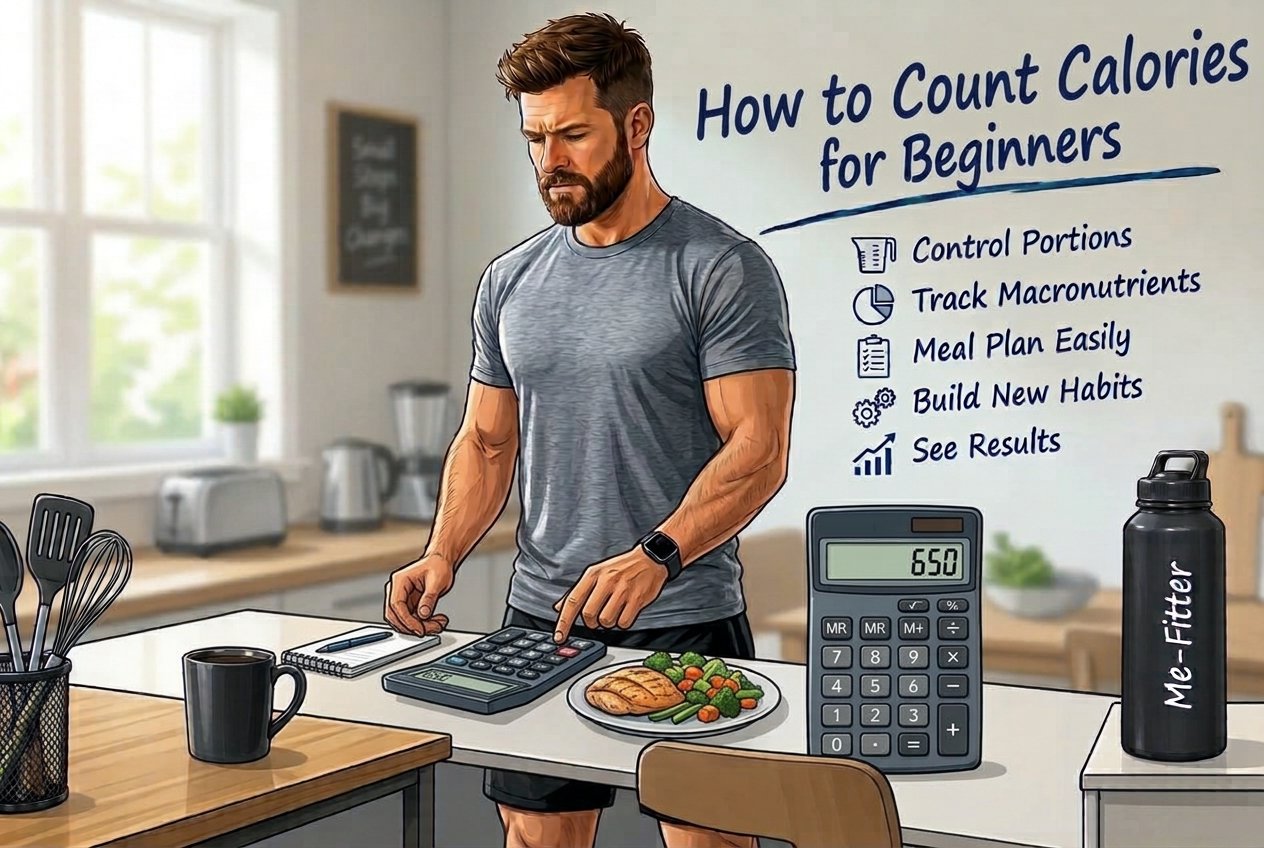
How to Count Calories for Beginners (2026): My Simple Method as a Busy Dad
The first week I counted calories was eye-opening. I tracked everything I ate and drank from day one, and I found out I was eating way more than I thought: about 2,000 calories a day more. Most of it came from drinks (soda, juice and milk) and snacks I would just grab and not count.
Quick answer (updated October 2026): To count calories as a beginner, find your daily calorie target with a calculator, then log everything you eat and drink in an app like Cronometer or on paper, weighing portions when you can. As a certified nutrition coach who lost 50 lbs, I found drinks, snacks and cooking oil were the calories I was missing.
As an Amazon Associate, I earn from qualifying purchases. If you buy through my links, I may earn a small commission at no extra cost to you.
Table of Contents
How to Count Calories for Beginners: 5 Simple Steps
Starting is simple: get your calorie target, pick a way to track, log everything, weigh what you can and watch your progress for a few weeks.
- Get your numbers. Use a calorie calculator to find a daily target. I used one similar to the free Me-Fitter calorie calculator I later built for this site.
- Pick how you will track. An app is easiest. I use Cronometer, and I compare the popular options in my weight loss apps guide. A notebook works too if you prefer old school.
- Log everything. Every food, drink, snack, condiment, spice and cooking fat. This is where most beginners go wrong (more on that below).
- Weigh what you can. A cheap food scale that reads in grams makes your numbers far more accurate. I have used a basic BAGAIL food scale for about four years, and I explain why in my food scale guide.
- Give it a few weeks, then adjust. Watch the trend on the scale, not one day, and adjust your target if your weight stops moving.
What My First Week of Counting Calories Taught Me
My first week showed me that the calories I was not counting mattered more than the meals I was.
I was eating about 2,000 calories a day more than I thought. The biggest sources were drinks like soda, juice and milk, plus snacks I grabbed without thinking. It also took me a few days to remember to log the small stuff: drinks, spices, condiments, and cooking oil and butter. Here is how fast those add up (approximate values from USDA FoodData Central):
| Easy-to-miss item | Approx. calories |
|---|---|
| 12 oz can of regular cola | About 155 |
| 1 cup (8 oz) orange juice | About 110 |
| 1 cup whole milk | About 150 |
| 1 tablespoon butter | About 100 |
| 1 tablespoon olive oil | About 120 |
| 1 tablespoon mayonnaise | About 95 |
What to Know Before You Start Counting Calories
Counting calories takes some time and attention at first, but it gets faster.
- It has to be a priority for a while. If you do not count, at least for a few months, you will never know if you are eating too much or not enough.
- The time drops quickly. In one 6-month study, people spent about 23 minutes a day logging food in month 1 and about 15 minutes by month 6. Those who logged in more often each day lost more weight (Harvey et al., 2019).
- Most people underestimate. In a well-known study, people who struggled to lose weight under-reported what they ate by about 47% (Lichtman et al., 1992). Tracking helps close that gap.
- It is not for everyone. Counting can become an obsession for some people. Research has linked calorie-tracking apps with more eating concerns in some users (Simpson & Mazzeo, 2017). If you have a history of disordered eating, talk to your doctor or a registered dietitian before you start, and consider hand portions instead.
How Accurate Is Calorie Counting?
Calorie counting is not perfectly accurate, but it is accurate enough to work if you are consistent.
Labels and menus are estimates. One study found restaurant meals averaged 18% more calories than stated, and supermarket frozen meals averaged 8% more (Urban et al., 2010). Guessing portions adds even more error. That is why I weigh food in grams when I cook at home: the box lists calories for a weight in grams, so if you do not measure in grams, your calories will be off.
You do not need perfect numbers. You need numbers that are close and consistent, so the trend on the scale tells you whether to adjust.
How I Count Calories on a Busy Workday
On a busy day, I plan my food out ahead of time instead of trying to log it on the fly.
I am a teacher with four kids and two jobs, so planning most of the time is what makes it work. These days I mostly eat the same meals in rotation, which makes tracking much easier because I already know the numbers. If you are busy too, pick a few go-to breakfasts and lunches, log them once and reuse them.
How to Count Calories When Eating Out
When I eat out, I look up the restaurant’s nutrition information online and estimate a bit for anything that does not match.
Eating out is where I have to be the most diligent. I stick to a few go-to places, like Chipotle, Subway and Taco Bell, so I know what I am getting. I share my usual orders in my healthy fast food guide. Since restaurant numbers can run high, it makes sense to round up rather than down.
How to Count Calories Without a Food Scale
Without a scale, use your hand to estimate portions and log those estimates.
I use hand portions when I am traveling, in a hurry or cooking for the whole family. My hand portion guide shows how: a palm of protein, a fist of veggies, a cupped hand of carbs and a thumb of fats. It is less precise than weighing, but far better than not tracking.
Do You Have to Count Calories Every Day?
At first, yes. Count every day for at least a few months so you learn what you are really eating.
After that, you may be able to ease off. I have, for the most part, because I eat the same meals in rotation and already know roughly where I land.
What If You Go Over Your Calorie Goal?
If you go over your calorie goal, do not freak out. Log it and get back to your plan at the next meal.
Going over happens to me, and it will keep happening. I just make sure it happens very sparingly. One high day does not undo weeks of consistency.
Why Isn’t Counting Calories Working?
The two most common reasons are calories you are not logging and a target that needs adjusting as you lose weight.
- Missing calories. Early on, I was not counting things like oil and butter, and those add up quickly. Check drinks, snacks, condiments and cooking fats first.
- Your target needs updating. As you lose weight, your body needs fewer calories, so the target that worked at the start eventually stops working (NIH Body Weight Planner). This has happened to me. Your body adjusts to the weight loss, and you have to readjust your calorie intake. Rerun the calorie calculator with your new weight.
- Not enough time. Daily weight bounces around. Judge progress over a few weeks, not a few days.
How Long Until You See Results From Counting Calories?
Most people can expect to lose about 1 to 2 pounds a week once they are consistently in a calorie deficit.
The CDC says people who lose weight at that gradual pace are more likely to keep it off (CDC). For the bigger picture on deficits and macros, see my calorie deficit and macros guide.
Calorie Counting FAQ
Can I lose weight just by counting calories?
Yes. Weight loss comes from eating fewer calories than you burn, and counting is a reliable way to make sure that happens. Exercise helps your health and your deficit, but counting alone can work.
What is the best free calorie counting app?
I use Cronometer, which has a free version. I compare Cronometer, Lose It!, MyFitnessPal and Noom in my weight loss apps guide.
Should I count calories or macros?
Start with calories, since they decide whether you lose weight. Once that habit is solid, tracking protein is a good next step. My calorie deficit and macros guide explains both.
Can I count calories without an app?
Yes. Write down what you eat and drink in a notebook and look up the calories on labels or a free database like USDA FoodData Central. It takes a little longer, but it works.
Is counting calories obsessive?
It can become an obsession for some people. For most, it is a short-term tool to learn what you are really eating. If tracking makes you anxious or you have a history of disordered eating, talk to a doctor or registered dietitian.
Final Thoughts
If a friend asked me how to start, here is what I would tell them: go to my calorie calculator, get your numbers, and then track them in an app or old school on paper. But just do it!