Portion Sizes Using Your Hand: A Simple Guide (No Food Scale)
If you’ve ever tried to lose weight by weighing every bite and logging every meal, you know how it usually ends. It works for a week or two, then life gets busy and the food scale goes back in the drawer. That was me for years.
What finally worked was much simpler: I stopped trying to be exact and started getting my portions about right, every day. The tool I used was already attached to my arm. This guide shows you how to use your hand to size portions of protein, veggies, carbs and fats at any meal, with no scale, no app and no counting.
Free printable: Get my Portion Control Cheat Sheet. Eyeball the right amount at any meal, with no scale and no counting. It includes a fridge chart, eating-out guide and wallet cards. Send it to me
What Is the Hand Portion Method?
The hand portion method uses four parts of your hand as measuring tools. It was popularized by the coaching company Precision Nutrition, and it’s become one of the most common ways coaches teach portion control to beginners.
Here’s why it works so well:
- It’s always with you. At home, at work, at a restaurant or at a cookout.
- It scales to your body. Bigger people usually have bigger hands and need more food. Smaller people usually have smaller hands and need less.
- It’s accurate enough. Precision Nutrition reports that hand portions come out about 95% as accurate as carefully weighing and tracking your food, with a lot less effort.
That last point is the big one. You don’t need perfect. You need close enough, most days, for months. That’s what actually moves the scale.
Your Hand Portion Guide
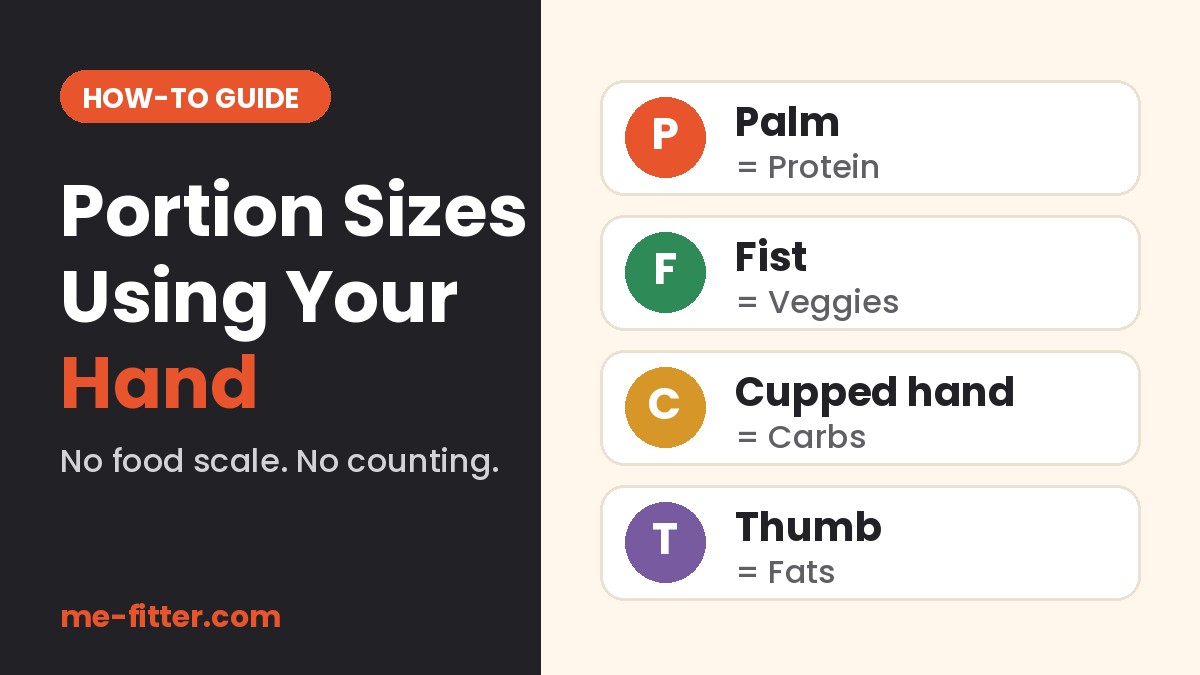
Each part of your hand matches one type of food:
| Hand portion | Food type | Examples | Roughly equals |
|---|---|---|---|
| Palm (thickness and width, no fingers) | Protein | Chicken, fish, lean beef, eggs, Greek yogurt, tofu | 3 to 4 oz cooked meat |
| Fist | Vegetables | Broccoli, salad greens, peppers, green beans, carrots | About 1 cup |
| Cupped hand | Carbs | Rice, pasta, potatoes, beans, oats, fruit | About 1/2 to 2/3 cup cooked |
| Thumb (whole thumb) | Fats | Oil, butter, nuts, nut butter, cheese, avocado | About 1 tablespoon |
How Many Portions Per Meal?
Here’s a simple starting point for each meal, based on Precision Nutrition’s guidelines:
| Most women | Most men | |
|---|---|---|
| Protein (palms) | 1 | 2 |
| Vegetables (fists) | 1 | 2 |
| Carbs (cupped hands) | 1 | 2 |
| Fats (thumbs) | 1 | 2 |
That’s it. Do that at each meal and you’ve built a balanced plate without looking up a single number.
Think of these as a starting point, not a rule. Your age, size, activity level and goals all change what you need. The next section shows you how to adjust.
How to Adjust Portions for Weight Loss
Start with the portions above for two weeks. Then look at what’s happening:
- Losing about 0.5 to 2 lbs a week and feeling okay? Keep doing exactly what you’re doing.
- Weight not moving? Remove one cupped hand of carbs or one thumb of fat from one or two meals a day. Keep protein and veggies the same.
- Hungry all the time or low on energy? Add a fist of veggies first. If that doesn’t help, add back a carb or fat portion at one meal.
Make one small change at a time and give it another two weeks. This is the same idea behind a calorie deficit. You’re just using your hand instead of an app to get there.
Why cut carbs or fats first? Protein helps you stay full and hold on to muscle while you lose weight (more on that in my guide to protein for weight loss), and veggies add volume for very few calories. Carbs and fats are where most of the extra calories hide.
What a Hand-Portion Meal Looks Like
Here are a few everyday meals built with the method. These use the “most men” portions. Cut each one in half for the “most women” version.
- Breakfast: 2 palms of eggs and Greek yogurt, 2 fists of peppers and spinach in the eggs, 2 cupped hands of oatmeal or fruit, 2 thumbs of cheese or nut butter.
- Lunch: 2 palms of grilled chicken, 2 fists of salad, 2 cupped hands of rice or beans, 2 thumbs of dressing or avocado.
- Dinner: 2 palms of salmon or lean beef, 2 fists of roasted broccoli, 2 cupped hands of potatoes, 2 thumbs of olive oil or butter for cooking.
An easy way to picture it: fill half your plate with veggies, a quarter with protein and a quarter with carbs, and add a little fat. The Build-a-Plate template in my free cheat sheet shows exactly this layout.
What About Mixed Dishes and Eating Out?
Real life isn’t a plate with four separate piles. For casseroles, pasta dishes, stir-fries and tacos, just make your best guess:
- Look at the main ingredients. A bowl of chili is mostly protein and carbs (meat and beans), plus some fat from cheese or sour cream.
- Eyeball the total size. A big bowl of pasta might be 3 or 4 cupped hands of carbs, not 1.
- Add a side of veggies to fill the gap, since most mixed dishes are light on them.
At restaurants, portions are often two or three times what you need. A few simple habits help:
- Find the protein first, then build the rest of your plate around it.
- Swap fries for a side salad or veggies when you can.
- Ask for sauces and dressings on the side (that’s where the thumbs of fat add up fast).
- Box up half before you start eating.
Precision Nutrition also suggests counting a regular alcoholic drink as about one cupped hand of carbs or one thumb of fat, and a strong or sweet cocktail as two.
My free cheat sheet includes a one-page eating out guide with what to order and skip at Italian, Mexican, Asian and fast food places.
Does It Work for Kids and the Whole Family?
Yes, and this is one of my favorite things about it. Because everyone uses their own hand, a child’s portions are automatically smaller than a parent’s. You can cook one family dinner and everyone serves themselves using their own hand.
Kids’ needs change a lot as they grow, so treat this as a simple guide for building balanced plates, not a way to restrict how much a child eats. If you have questions about your child’s nutrition, talk with your pediatrician.
Common Mistakes to Avoid
- Using your fingers in the palm portion. A palm is the palm only, about as thick as your hand.
- Heaping the cupped hand. It’s what fits in your hand, not a mountain on top of it.
- Forgetting hidden fats. Cooking oil, butter on toast, cheese on a salad and creamy dressings all count as thumbs.
- Ignoring snacks and drinks. A handful of chips, a latte or a soda counts too.
- Chasing perfect. Some meals will be off. That’s fine. What you do most days matters much more than any single meal.
Hand Portions vs. Counting Calories
If you already count macros or calories and like it, keep going. The hand method can still make logging faster, especially for meals out.
But if tracking feels like a second job, or you’ve quit tracking before, the hand method is a great place to start. You get most of the benefit with a lot less effort, and you’re much more likely to stick with it. If you want something in between, portion control containers are another easy option for meal prep at home.
Frequently Asked Questions
How big is a palm-sized portion of meat?
For most people it’s about 3 to 4 ounces of cooked meat, roughly the size and thickness of a deck of cards.
Can I lose weight with the hand portion method?
Yes. Hand portions are simply an easy way to control how much you eat. If your portions put you in a calorie deficit, you’ll lose weight. Use the adjustment steps above if progress stalls.
What if I have really big or small hands?
That’s the point of the method. Hand size tends to match body size, so your portions scale with you. If results are off after a couple of weeks, adjust the number of portions, not the method.
Do I need to eat four meals a day?
No. Eat the number of meals that fits your life. If you eat fewer meals, you may need a little more at each one. Let your results and your hunger guide you.
The Bottom Line
You don’t need a food scale or an app to control your portions. Use a palm for protein, a fist for veggies, a cupped hand for carbs and a thumb for fats. Start with the basic portions, check your progress every two weeks, and make one small change at a time.
That simple approach is a big part of how I lost 50 lbs without giving up the foods my family loves. You can read the whole story in my simple weight loss plan.
This article is for general education and isn’t medical advice. If you have a medical condition, are pregnant or have a history of disordered eating, talk with your doctor or a registered dietitian before changing how you eat.
Sources
- Precision Nutrition. Forget calorie counting: Try this calorie control guide for men and women.
- Precision Nutrition. Hand Portion FAQ.