Walking With a Weighted Vest: Benefits, How Heavy to Go, and a 6-Week Beginner Plan
This post contains affiliate links. If you buy through them, I may earn a small commission at no extra cost to you. See my affiliate disclosure.
Introduction
Walking is the easiest workout to stick with. You don’t need a gym, a plan, or any skill. The problem is that once your body gets used to it, a regular walk stops pushing you very hard.
A weighted vest fixes that without changing the habit you already have. You walk the same route at the same pace, but your legs, hips, and core work harder with every step, and you burn a few more calories along the way.
This guide covers what walking with a weighted vest actually does (and what the research says it doesn’t do), how heavy your vest should be, how long to walk, and a simple 6-week plan to build up safely.
Table of Contents
Quick Answer
- Start light: about 5% of your body weight, then build toward 10%.
- Start short: 15–20 minutes, 2–3 times a week, before adding time or weight.
- Expect a modest calorie boost: roughly 10–13% more than walking without a vest at the same pace.
- Add hills for the biggest payoff: incline raises calorie burn more than extra vest weight does.
- Don’t count on the vest alone for bones: pair it with strength training.
Benefits of Walking With a Weighted Vest
1. You Burn More Calories on the Same Walk
Carrying extra weight takes extra energy. In a study sponsored by the American Council on Exercise, women walked on a treadmill at 2.5 mph wearing vests equal to 0%, 10%, and 15% of their body weight. With a vest, they burned about 11–13% more calories than without one, depending on the incline (ACE study).
That’s a real boost, but it’s not magic. If a normal hour of walking burns about 250 calories for you, a vest might add around 30. Over weeks of regular walking, that adds up. It won’t replace eating in a calorie deficit, though.
2. Hills Give You More Than Extra Weight
The same ACE study found that incline had a bigger effect on calorie burn than vest weight. At steeper grades, a 15% vest didn’t burn meaningfully more than a 10% vest. The researchers recommended a vest around 10% of body weight for incline walking.
So before you buy a heavier vest, try adding a hill or raising the treadmill incline. If you like treadmill workouts, my guide to inclined walking for weight loss is a good place to start.
3. Your Walk Turns Into Light Strength Work
The added load makes your glutes, quads, calves, and core work harder to carry you forward and keep you upright. It’s not a replacement for lifting, but it’s a step up from a regular walk, especially if you sit most of the day. For more ways to use the vest beyond walking, see my weighted vest training guide.
4. It’s Easier on Your Joints Than Running
Walking keeps one foot on the ground at all times, so the impact stays low. A vest lets you raise the effort without switching to running, which can be hard on knees, hips, and feet, especially if you’re carrying extra body weight.
5. What the Research Says About Bones and Balance
Weighted vests get a lot of attention for bone health, so it’s worth being honest about what the research shows.
In the INVEST trial, 150 older adults with obesity followed a weight-loss program for 12 months. One group wore a weighted vest about 7 hours a day. The vest did not prevent the hip bone loss that came with weight loss, compared with dieting alone. The resistance-training group didn’t prevent it either (JAMA Network Open, 2025).
The Wake Forest researchers behind the study still see value in vests. They point to benefits for balance and knee strength. For protecting bone, they recommend progressive resistance training with impact, enough protein, and calcium and vitamin D (Wake Forest News).
The takeaway: a vest is a helpful add-on, not a bone-health plan by itself. If you have osteoporosis or low bone density, read my post on weighted vests and bone density and talk with your doctor first.
6. It Fits Into What You Already Do
The best exercise is the one you’ll keep doing. If you already walk the dog, walk at lunch, or try to hit 10,000 steps a day, a vest makes those minutes count for more without adding anything new to your schedule. For the bigger picture, see walking for fat loss.
How Heavy Should Your Weighted Vest Be for Walking?
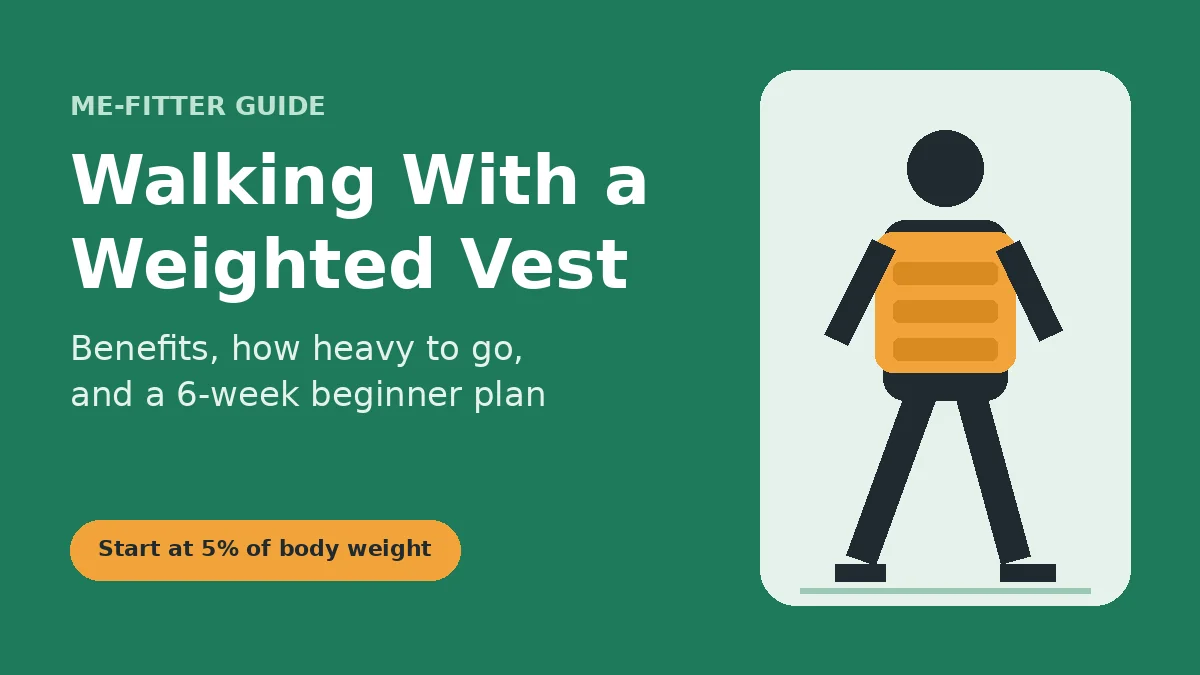
Start lighter than you think. Most people do best beginning around 5% of their body weight and working up to about 10%. Experienced walkers can go to 15%, but for everyday walking there’s little reason to go heavier than that.
| Your body weight | Starting vest (about 5%) | Goal vest (about 10%) |
|---|---|---|
| 130 lb | 6–7 lb | 13 lb |
| 150 lb | 7–8 lb | 15 lb |
| 180 lb | 9 lb | 18 lb |
| 200 lb | 10 lb | 20 lb |
| 250 lb | 12 lb | 25 lb |
If you weigh more, you don’t have to scale all the way up. Your body is already carrying a heavy load, so a 10–15 lb vest is plenty to start. An adjustable vest with removable weights makes it easy to build up gradually.
How Long and How Often to Walk
- Beginners: 15–20 minutes, 2–3 days a week, with a rest day between vest walks.
- After a few weeks: 30–45 minutes, 3–4 days a week.
- Regular walks without the vest: keep doing them on the other days. Not every walk needs extra weight.
Increase one thing at a time: time, weight, or incline. If you add weight, keep the time the same that week.
6-Week Beginner Weighted Vest Walking Plan
| Week | Vest weight | Walks per week | Time per walk | Terrain |
|---|---|---|---|---|
| 1 | About 5% of body weight | 2 | 15–20 min | Flat |
| 2 | About 5% | 3 | 20–25 min | Flat |
| 3 | About 7–8% | 3 | 20–25 min | Flat |
| 4 | About 7–8% | 3 | 30 min | Add gentle hills |
| 5 | About 10% | 3 | 30 min | Flat or gentle hills |
| 6 | About 10% | 3–4 | 30–45 min | Mix in hills or incline |
Walk at a pace where you could still hold a conversation. If your back, knees, or feet feel sore the next day, repeat the previous week before moving on.
Want this plan on your fridge? Get the free printable Weighted Vest Walking Plan. It includes the vest weight chart, the 6-week plan with a walk tracker, and 3 at-home vest workouts.
Form Tips for Walking With a Vest
- Wear it snug. A loose vest bounces and pulls on your shoulders. Tighten the straps so it doesn’t shift when you walk.
- Stand tall. Keep your chest up and shoulders relaxed. If you start leaning forward, the vest is too heavy.
- Keep your normal stride. Don’t shorten your steps or shuffle to compensate for the weight.
- Swing your arms. It helps with balance and keeps your upper body loose.
- Wear supportive shoes. Extra weight means extra load on your feet.
- Drink water. Vests trap heat, so you’ll sweat more than usual, especially in summer.
Safety: Who Should Be Careful
Walking with a weighted vest is safe for most healthy adults who build up gradually. Talk with your doctor before starting if you have:
- Back, neck, hip, knee, or ankle problems
- Osteoporosis or a history of fractures
- Heart or blood pressure conditions
- Balance problems or a history of falls
- A pregnancy
Stop and rest if you feel sharp pain, dizziness, or chest discomfort. Skip running or jumping in your vest until you’re comfortable walking in it. For a deeper look, see is a weighted vest safe?
Weighted Vest vs. Rucking vs. Ankle Weights
Weighted vest: spreads weight across your chest and back, so it’s the most balanced option for walking.
Rucking: weight in a backpack. It’s cheap and effective but puts more of the load behind you. See rucking for weight loss.
Ankle weights: not a good fit for walking. They change the way your legs swing and can strain your knees and hips.
For the full side-by-side, read weighted vest vs. ankle weights vs. rucking.
Choosing a Weighted Vest for Walking
For walking, look for a vest that:
- Has adjustable or removable weights, so you can start light and build up
- Fits close to your body without bouncing
- Has breathable material and padded shoulders
- Doesn’t block your arm swing
I compare my top picks in the best weighted vests for walking, running, and strength training. If you want a direct pick, the ZELUS Weight Vest on Amazon is a popular budget option. You can also read my Invest Pro weight vest review.
FAQ
Can I walk with a weighted vest every day?
Once you’re used to it, yes, as long as you feel recovered. When you’re starting out, stick to 2–3 vest walks a week with rest days between them.
Will walking with a weighted vest help me lose belly fat?
It can help you burn more calories overall, which supports fat loss. But you can’t target fat loss to one spot. Belly fat comes off along with fat everywhere else, mostly from a consistent calorie deficit.
Is a 20 lb weighted vest too heavy for walking?
It depends on your body weight and experience. For a 200 lb person, 20 lb is about 10% and a reasonable goal. For a 130 lb beginner, 20 lb is too heavy to start. Begin around 5% of your body weight.
Should I wear a weighted vest all day?
You don’t need to. In the INVEST trial, wearing a vest about 7 hours a day during weight loss didn’t prevent hip bone loss. Short, focused walks are an easier way to get the benefits.
How many more calories does a weighted vest burn?
Research shows about 10–13% more with a vest around 10–15% of body weight. Adding incline increases your burn even more.
The Bottom Line
Walking with a weighted vest is a simple way to get more out of the walks you’re already taking. Start around 5% of your body weight, build to about 10%, add hills when you’re ready, and pair it with strength training for the best results.